

Few running injuries test your patience quite like an irritated Achilles tendon. That stiff, tender ache when you take your first barefoot steps out of bed in the morning is your body’s blunt way of telling you that your calves and connective tissue can’t handle the current workload.
While targeted strength work, heavy slow resistance, and eccentric calf drops aren’t optional for real healing, what you lace up every day makes a massive difference in how much tension yanks on that tendon with each stride. A shoe with an elevated 8mm to 10mm drop works like a gentle heel wedge, shortening how far the tendon has to stretch when your foot hits the ground. Pair that with a rockered sole or a steady heel counter, and you’ll keep logging easy miles without setting your recovery back to square one. Here are six road shoes that give your lower legs real mechanical relief.
Best Running Shoes for Achilles Tendonitis: Our Top Picks
- Best Overall Daily Pick: Brooks Ghost 18
- Best for Inward Ankle Rolling: Brooks Adrenaline GTS 25
- Best Max Cushion for Hard Roads: ASICS Gel-Nimbus 28
- Best Rocker for Easy Push-Off: Saucony Triumph 24
- Best Ground-Connected Feel: Nike Pegasus 42
- Best Firm Level Heel Support: Mizuno Wave Rider 30
Best Overall Daily Pick
Brooks Ghost 18

- ✓Elevated 10mm heel drop takes immediate stretch off tight calf muscles
- ✓Balanced DNA LOFT v3 foam protects your heel without letting your foot sink backwards
- ✓Generously padded heel collar cushions the back of your ankle without pinching
PROS
- + Protective 10mm heel lift
- + Stable non-squishy cushion
- + Plush rearfoot lockdown
CONS
- – Firm traditional heel landing
- – Stiff forefoot flex
The Ghost is boring, and when your Achilles is barking at you, that lack of drama is exactly what you’ll want. It’s not a bouncy super-shoe, and it won’t trick you into running faster than you should on an easy day. But its 10mm heel drop acts like a built-in heel lift, keeping your ankle from bending too far downward and pulling on that tight tendon cord. The nitrogen-infused foam’s soft enough to absorb road thud, but firm enough that your heel won’t sink into the shoe and undo the benefits of that high drop.
Around the back, Brooks gives you thick, old-school collar padding that holds your heel bone firmly in place without clamping down on the sore spot where the tendon inserts into the bone. The rubber outsole’s durable and grips reliably on wet asphalt. If you just want a simple, honest daily sneaker that lets your lower legs quietly heal while you keep your routine, this is the safest pick on the wall. For more details on how it handles regular mileage, check out our Brooks Ghost 18 review.
- Why it wins: Its 10mm drop and firm rearfoot support take immediate tension off tight calves without fancy gimmicks.
- Key Feature: Swaps in DNA LOFT v3 nitrogen foam for a slightly softer landing that doesn’t pack out.
- Best For: Runners who want a simple, protective daily trainer with a high drop and a solid, stable heel.
Best for Inward Ankle Rolling
Brooks Adrenaline GTS 25

- ✓Firm foam GuideRails nudge your heel straight to prevent awkward side-to-side tendon twisting
- ✓High 10mm drop shortens the calf stretch on every road landing
- ✓Breathable mesh upper with a snug, locked-in midfoot fit
PROS
- + Stops ankle rolling
- + Protective 10mm drop
- + Durable road grip
CONS
- – Stiffer underfoot feel
- – Heavier structured platform
If your ankles roll inward when you land, your Achilles gets pulled at an awkward angle on every footstrike instead of tracking straight. Over miles of running, that uneven twisting is often what keeps a flared tendon from settling down. The Adrenaline GTS 25 handles that with GuideRails, which are essentially raised foam bumpers on either side of your heel. If your foot stays centered, you won’t even feel them; if your form starts breaking down at the end of a long run, they’ll keep your heel tracking straight.
Underfoot, full-length DNA LOFT v3 foam takes the edge off concrete without feeling mushy. The heel counter’s rigid and supportive, but lined with enough cushion that it won’t press painfully into an inflamed tendon sheath. If you know you overpronate, or your running shoes always show heavy wear on the inner heel, this is the shoe that stops the twisting and lets the tendon rest.
- Why it wins: Its GuideRails stop lateral heel twisting without feeling like a stiff medical orthotic under your foot.
- Key Feature: Integrates full-length nitrogen-infused DNA LOFT v3 cushioning for a lighter, more energetic ride.
- Best For: Runners whose feet roll inward on impact and need stability to stop side-to-side twisting on the tendon.
Best Max Cushion for Hard Roads
ASICS Gel-Nimbus 28
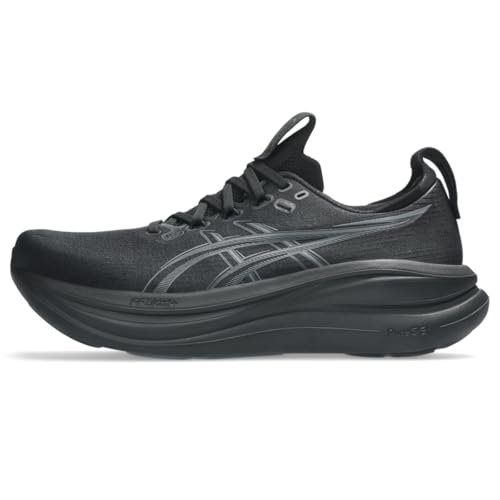
- ✓Towering 43.5mm heel stack with PureGEL absorbs hard concrete shock
- ✓Wide base prevents excessive ankle wobble despite the tall cushion height
- ✓Soft stretchy knit collar won’t rub or dig into the back of your heel
PROS
- + Deep impact absorption
- + Friction-free heel collar
- + Wide stable base
CONS
- – Muffled road feel
- – Knit upper runs warm
When your tendon’s so sensitive that every footstrike on hard asphalt feels like a direct hit, max cushioning can save your sanity. The Nimbus 28 gives you 43.5mm of foam under the heel, which completely dampens the sting of road running. Even better, ASICS made the platform wide, so you won’t feel like you’re balancing on a narrow balance beam.
The real selling point for Achilles sufferers, though, is the collar. Rigid plastic heel counters are notorious for pressing right into the tendon insertion and causing bursitis. The Nimbus uses a stretchy, pillowy engineered knit that hugs your ankle like a cozy sock with zero hard pressure points. It’s not built for fast intervals, but for easy, low-stress recovery miles, it’s about as forgiving as a running shoe gets.
- Why it wins: Its PureGEL heel insert eats road shock, and the soft knit collar won’t rub an inflamed tendon insertion.
- Key Feature: Slightly widens the midfoot base platform and refines upper ventilation for enhanced long-run stability.
- Best For: Runners who land heavily on their heels and want maximum shock absorption with a soft, friction-free heel collar.
Best Rocker for Easy Push-Off
Saucony Triumph 24

- ✓Curved rocker sole rolls you forward smoothly so your calves work less at toe-off
- ✓Springy incrediLUX foam cushions deep without feeling sluggish
- ✓Contoured rearfoot heel cup cradles the ankle without irritating the tendon
PROS
- + Effortless rocker roll
- + Bouncy lightweight foam
- + Padded ankle collar
CONS
- – Curved sole feels different
- – High price tag
The hardest part of running with Achilles pain is push-off. When your foot bends back to propel you forward, your calf has to fire at peak force, which yanks hard on the tendon. The Triumph 24 solves this with a curved rocker sole. Instead of your toes bending deeply against the pavement, the curved shape rolls your foot forward almost on its own.
Saucony built this shoe with incrediLUX foam, which feels lively and springy without that sloppy, sinking sensation of marshmallow midsoles. Combined with a protective 10mm drop, it takes the strain off both ends of your stride: the drop eases the landing, and the rocker eases the toe-off. If you want maximum cushion that still feels energetic and smooth, that’s what makes this shoe special.
- Why it wins: Its curved rocker and 10mm drop work together to reduce both calf stretch and push-off strain.
- Key Feature: Features newly engineered incrediLUX foam that cuts overall weight while boosting energy return.
- Best For: Runners who want deep cushioning paired with an effortless forward roll that takes the bite out of toe-off.
Best Ground-Connected Feel
Nike Pegasus 42

- ✓Classic 10mm drop keeps your calves relaxed on everyday road miles
- ✓Curved heel collar sweeps backwards away from the Achilles tendon
- ✓ReactX foam and Air Zoom unit offer snappy pop without extra bulk
PROS
- + Protective 10mm heel lift
- + Snappy Air Zoom rebound
- + Achilles-friendly collar sweep
CONS
- – Firmer road feel
- – Snug fit through midfoot
Not everyone wants to run on four inches of foam. If you hate maximalist shoes and want a traditional, ground-connected trainer that still protects your Achilles, the Pegasus 42’s the answer. It maintains that sweet-spot 10mm heel drop that unloads tight calves, but it keeps you close enough to the pavement that you’ll feel nimble and agile through corners.
Nike also shaped the heel collar with a slight backward flare, which keeps the upper from pressing or rubbing against the tender cord behind your ankle. Inside, the combination of ReactX foam and a full-length Air Zoom unit gives you a snappy, energetic bounce without the sluggish drag of heavier shoes. It’s a tough, dependable road trainer that holds up for hundreds of training miles without changing its feel.
- Why it wins: It delivers a classic 10mm drop with a snappy Air Zoom pop and an articulated collar that avoids tendon friction.
- Key Feature: Introduces a full-length curved Air Zoom unit integrated directly into responsive ReactX foam.
- Best For: Neutral runners who want a responsive, connected everyday road shoe with a protective 10mm heel lift.
Best Firm Level Heel Support
Mizuno Wave Rider 30

- ✓Full-length Pebax Wave Plate spreads landing impact evenly across the sole
- ✓Taller 42.5mm Enerzy NXT heel stack cushions without losing structural firmness
- ✓Firm heel counter locks the rearfoot firmly in place to prevent side wobble
PROS
- + Level mechanical stability
- + Substantial heel protection
- + Ultra-durable carbon outsole
CONS
- – Firmer mechanical ride
- – Little forefoot sink
Physical therapists have recommended Mizuno’s Wave Rider for years for one straightforward reason: it doesn’t wobble. When your Achilles is flared up, soft foam that squishes unevenly under your heel is your worst enemy. The Wave Rider 30 sandwiches a stiff plastic Wave Plate between two layers of foam. When your heel lands, that plate spreads the impact force sideways across the whole shoe, keeping your foot level and steady instead of tipping inward or outward.
The 30th edition has a taller 42.5mm stack of Enerzy NXT foam, giving you plenty of cushioning for long asphalt runs while maintaining that signature firm, structured ride. The knit upper locks your heel down securely, and the X10 carbon rubber on the outsole will outlast almost anything else in your closet. If squishy shoes leave your lower legs feeling wobbly or exhausted, this firm mechanical platform is your best bet.
- Why it wins: Its full-length Wave Plate spreads landing shock laterally, keeping the rearfoot stable and level.
- Key Feature: Introduces a full-length Wave Plate paired with a taller 42.5mm stack of nitrogen-infused MIZUNO ENERZY NXT foam.
- Best For: Runners who prefer a firm, mechanical stability plate that keeps heel strike impact level and steady.
How to Choose the Best Running Shoes for Achilles Tendonitis
Aim for an 8mm to 10mm Heel Drop
Heel drop is the height gap between the foam under your heel and your toes. Low-drop shoes force your ankle to flex deeply on every landing, stretching the Achilles far too tight.
An 8mm to 10mm drop acts like a gentle wedge under your heel. It shortens how far the tendon stretches at impact, giving your calves immediate relief. If you’re new to drop measurements, check out our guide on what is heel to toe drop.
Avoid Marshmallow Foams (Pick Rockers Instead)
Ultra-squishy foam is a common trap. When your heel sinks deep into soft foam, your rearfoot drops lower than your toes mid-stride, pulling hard on your tendon.
Instead, choose a balanced running shoe stack height paired with a rocker sole. A gentle curved rocker rolls your foot forward smoothly so your Achilles doesn’t have to forcefully yank you into toe-off.
Match the Heel Collar to Where It Hurts
Where your tendon aches dictates the collar shape you need:
- Mid-portion pain (above the heel): Focus on higher drops and rockers to offload the pulling cord.
- Insertional pain (at the heel bone): Avoid rigid plastic heel counters that curve inward and rub the bone. Choose soft knit collars (like the Gel-Nimbus 28) or backward-flared collars (like the Pegasus 42) that leave that tender zone friction-free.
Inspect your older trainers with our Shoe Wear Pattern Analysis Tool to see if uneven heel breakdown’s twisting your ankles, and consult our guide on how to choose running shoes to size for natural swelling.
Wrapping Up: Finding Sustainable Relief for Your Achilles
No running shoe is a magic cure for Achilles tendonitis. Real healing comes from patience, progressive calf strength, and giving the tissue time to rebuild. But the right pair of shoes can take enough mechanical load off your lower legs each day that your rehab’s actually got room to work.
If you want predictable, time-tested protection, the Brooks Ghost 18 or Adrenaline GTS 25 keep things stable and steady without any fuss. If hard pavement shocks are aggravating your tendon, the ASICS Gel-Nimbus 28 gives you deep cushioning without a biting collar, while the Saucony Triumph 24 rolls you forward effortlessly. Pick the pair that matches how your foot lands, keep your recovery exercises consistent, and you’ll give your tendon the support it needs to bounce back.
Frequently Asked Questions
What heel-to-toe drop is best for Achilles tendonitis?
A drop between 8mm and 12mm is ideal. Raising the heel shortens how far your calf’s got to stretch at mid-stance, which takes immediate mechanical strain off the tendon.
Can I run in zero-drop shoes with Achilles pain?
You’ll definitely want to steer clear of zero-drop shoes during active Achilles flare-ups. Dropping your heel level with your toes increases the tendon’s stretch on every stride, which keeps irritated tissue inflamed.
Why do overly soft running shoes bother my Achilles?
When foam’s too soft, your heel sinks down under your body weight upon landing. That sinking motion drops your rearfoot lower than your forefoot, forcing your calf to work overtime just to keep your ankle steady.
Should I stretch my calves if my Achilles is irritated?
Avoid aggressive calf stretching off curbs during acute flare-ups, especially if your pain’s right at the heel bone. Deep stretching compresses the tendon against the bone and often makes inflammation worse. Focus on gentle ankle mobility and isometric heel holds instead.
Do temporary heel lifts help?
Yes, slipping a small 4mm to 6mm silicone heel lift into your daily shoes can provide immediate relief during acute flare-ups. Think of it as a temporary crutch to calm the tendon while you rebuild strength.
How do I know if my run was too much for my tendon?
Use the 24-hour response rule. Mild discomfort during a run is generally acceptable if it stays under a 3 out of 10 and doesn’t get sharper. The real test is the next morning: if your stiffness clears up within 5 to 10 minutes, your tendon handled the workload. If you’re limping across the room, you ran too far or too fast.
