

The trail running landscape has shifted dramatically this year. We’ve moved past the experimental phase into an era where premium features—like Vibram outsoles and nitrogen-infused foams—are finally standard.
After analyzing the latest 2026 releases, we’ve ranked the top performers by category. Whether you’re running casual trails or a 100-mile ultra, these are the best shoes for the job.
At a Glance: The 2026 Best Trail Shoes
- Best Overall Trail Shoe: Saucony Peregrine 16
- Best Max Cushion: Hoka Speedgoat 7
- Best Road-to-Trail Hybrid: Hoka Challenger 8
- Best Stability & Protection: Brooks Cascadia 19
1. Saucony Peregrine 16
Best Overall Trail Shoe

Saucony Peregrine 16
- ✓Push your mileage further with less foot fatigue than previous versions.
- ✓Trust your footing on wet rocks and slippery roots without hesitation.
- ✓React quickly to changing terrain thanks to a nimble, low-profile feel.
PROS
- + Vibram Megagrip is finally standard
- + Increased cushioning extends range to 50k+
- + Versatile fit works for most foot shapes
CONS
- – Slightly less ground feel than previous low-stack versions
- – Standard mesh upper isn’t as high-tech as Matryx options
- Released: January 2026
The Peregrine has long been the reliable workhorse of trail shoes, but the 16th iteration gets a massive upgrade that makes it something special. The switch to a full Vibram Megagrip outsole addresses the series’ biggest historical weakness (wet traction). Combined with a slightly taller stack of PWRRUN foam, it’s now capable of ultra-distances without losing its legendary agility.
Peregrine 16 Trending on Social
- Who It’s For: The versatile runner who wants one shoe to handle everything from easy off-roading to technical trails.
- Key Update: Now features a full Vibram Megagrip outsole, replacing the slippery proprietary rubber of previous versions.
KEY SPECS
2. Hoka Speedgoat 7
Best Max Cushion
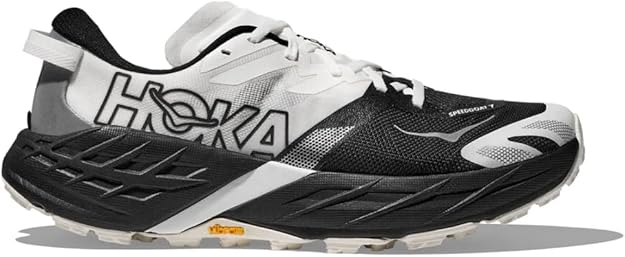
Hoka Speedgoat 7
- ✓Experience a bouncy ride that resists packing out over long ultra-marathons.
- ✓Power up loose gravel climbs with micro-textured lugs that bite into the dirt.
- ✓Lock your foot securely in place to prevent toe-jamming on steep descents.
PROS
- + Supercritical foam offers “endless” bounce
- + Traction Lugs provide enhanced grip
- + Secure lockdown
CONS
- – Toe box is still tapered/narrow
- – High stack creates a muted ground feel
- Released: February 2026
The King of Cushion returns to the throne. After a polarizing version 6, the Speedgoat 7 fixes the fit issues with a new woven upper that actually locks the midfoot down. The headline feature, however, is the new supercritical EVA midsole, which is lighter and far more resilient than the old foams, preventing the shoe from “packing out” late in a race.
Hoka Speedgoat Trending on Social
- Who It’s For: Ultrarunners and hikers seeking maximum joint protection and a “locked-in” fit for technical terrain.
- Key Update: Upgraded to supercritical EVA foam for better energy return and longevity compared to the old compression-molded foam.
KEY SPECS
3. Hoka Challenger 8
Best Road-to-Trail Hybrid

Hoka Challenger 8
- ✓A massive 42mm heel stack absorbs asphalt pounding so your joints don’t have to on the way to the trail.
- ✓Tightly spaced center lugs provide a smooth, silent ride on road sections without the “cleat buzz” of technical shoes.
- ✓The wide base provides inherent stability, preventing the “tippy” feeling common in high-stack shoes.
PROS
- + Smooth transition on hard surfaces
- + High durability for a Hoka model
CONS
- – Exposed foam on the outsole can get chewed up by sharp rocks
- – Unstable on highly technical, off-camber terrain
- Released: July 2025
For the runner who has to pound 3 miles of pavement to get to the trailhead. The Challenger 8 mimics the plush ride of a max cushion shoe like the Hoka Clifton 10 but adds a durable outsole with tightly spaced center lugs that allow for smooth road running. It’s not for technical alpine ridges, but for gravel, dirt paths, and urban trails, it’s a beast.
Hoka Challenger Trending on Social
- Who It’s For: The road-to-trail runner who splits their mileage 50/50 between pavement and dirt.
- Key Update: Increased stack height to 42mm (heel) for max cushion-like comfort on pavement.
KEY SPECS
4. Brooks Cascadia 19
Best Stability & Protection

Brooks Cascadia 19
- ✓The “Trail Adapt” system adjusts to uneven ground to prevent ankle rolls when your form falls apart at mile 40.
- ✓Nitrogen-infused DNA Loft v3 foam finally injects some fun into a shoe historically known for being dull.
PROS
- + Bombproof protection against rocks and roots
- + Incredibly stable on uneven ground
- + Nitrogen-infused foam sheds the “heavy” feel of older models
CONS
- – Still heavier than its competitors
- – Stiff ride requires a break-in period
- Released: August 2025
If you prioritize not getting injured over running fast, this is your shoe. While the Cascadia isn’t the fastest shoe it features the new “Trail Adapt” system—an integrated rock plate and stability post setup that resists twisting. The Cascadia 19 also upgrades to DNA Loft v3, making it surprisingly lively for such a protective tank.
Brooks Cascadia Trending on Social
- Who It’s For: Hikers and runners who prioritize stability and foot protection over speed.
- Key Update: Adoption of nitrogen-infused DNA Loft v3 foam, making the shoe lighter and bouncier than previous “clunky” versions.
KEY SPECS
Frequently Asked Questions (FAQs)
How should a trail running shoe fit?
Trail shoes should fit slightly differently than road shoes. You need a secure midfoot lockdown to prevent your foot from sliding inside the shoe on uneven ground, but you also need a thumb’s width of space in the toe box. When you run downhill, your feet slide forward; if your shoes are too tight, your toes will hit the front, leading to black toenails and blisters.
Are waterproof (GTX) trail shoes better?
Not always. Waterproof shoes (often labeled GTX for Gore-Tex) are great for snow, slush, and shallow puddles. However, they are less breathable than non-waterproof shoes. If water gets inside a waterproof shoe (during a deep creek crossing or heavy rain), it cannot drain out, leaving you with heavy, wet feet. For most 3-season running, a non-waterproof shoe that drains and dries quickly is preferred.
How many miles do trail running shoes last?
Generally, trail shoes last between 300 and 500 miles. However, this varies by terrain. Running on abrasive granite or pavement will wear down rubber lugs faster than running on soft dirt. Lighter “racing” shoes (like the NNormal Kjerag) may wear out faster than robust “tanks” like the Brooks Cascadia.
