
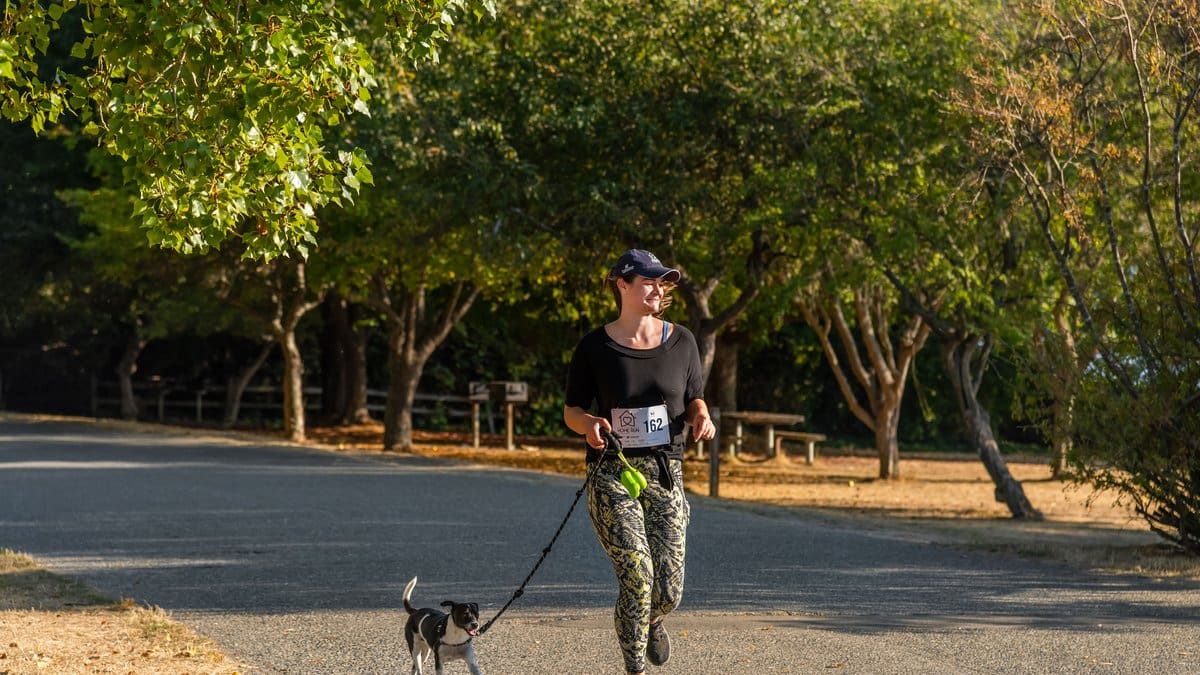
There’s nothing quite like hitting the quiet morning pavement with your dog bounding beside you. Four-legged running partners don’t complain about early alarms, they’ll never critique your split times, and their boundless enthusiasm turns routine recovery loops into genuinely joyful adventures.
However, running with a dog requires far more preparation than simply clipping a leash to a flat collar and heading out the front door. Dogs don’t possess the same cooling systems that humans rely on, their juvenile skeletal frames take over a year to mature, and their bare paw pads absorb every ounce of friction on hot asphalt. Most critically, dogs are eager people-pleasers: a loyal companion will push through severe fatigue, torn pads, and heat exhaustion just to keep up with your stride.
Taking the time to build your dog’s cardiovascular stamina gradually protects their long-term health while keeping your own training on track. Whether you’re training an energetic retriever or jogging with an athletic mixed breed, here’s the veterinary-backed guide on how to start running with your dog safely, along with essential form cues and the right gear so you’ll both thrive on the run.
How to Start Running With Your Dog: What You Need to Know
- Assessing Your Dog’s Running Readiness
- Safe Pavement Habits & Temperature Checks
- Form, Leash Technique, & Shoulder Freedom
- Trail Hazards, Hydration, & Paw Pad Defense
- Building a Progressive Starter Mileage Plan
Assessing Your Dog’s Running Readiness
Before you log your first training mile together, your dog needs a formal medical green light from your veterinarian. Running places continuous, repetitive concussive force on your dog’s joints and tendons that casual backyard play simply doesn’t replicate.
Breed Anatomy & Distance Capacity
Not every dog breed is anatomically suited for sustained distance running. Working, herding, and sporting breeds like German Shorthaired Pointers, Border Collies, Vizslas, Australian Shepherds, and Labrador Retrievers possess long limbs and deep chest cavities that thrive on aerobic work.
Conversely, brachycephalic (flat-faced) breeds like French Bulldogs, Pugs, and Boxers suffer from shortened upper airways that make cooling down during prolonged running nearly impossible. Similarly, giant breeds like Great Danes carry excessive skeletal mass that experiences rapid joint wear under repetitive impact. If you aren’t sure about your dog’s anatomical suitability, ask your vet for an honest assessment of their structural frame before starting.
Why Growth Plates Must Close Before Structured Miles
The most critical safety rule in conditioning an active running dog is waiting for growth plates to fully close. In young puppies, the ends of the long leg bones contain soft cartilaginous zones where new bone tissue develops. Subjecting these vulnerable growth plates to continuous pounding on hard road surfaces can cause premature closure, leading to angled limb deformities, lifelong hip issues, and early-onset osteoarthritis.
Guidelines from the American Veterinary Medical Association recommend waiting until your dog is between 12 and 18 months old before beginning structured running workouts. Larger breeds take even longer to reach complete skeletal maturity. Until your veterinarian confirms via physical exam or X-rays that your dog’s growth plates are solid bone, stick to self-directed off-leash romping on grass where your puppy can stop, sit, and rest whenever they’re ready.
Safe Pavement Habits & Temperature Checks
Humans are exceptionally efficient cooling machines because we’ve got millions of active sweat glands distributed across our entire body surface. Dogs don’t have this luxury. They rely almost exclusively on panting to exchange warm internal air for cooler ambient air, supported by a tiny concentration of sweat glands in their paw pads.
The 7-Second Asphalt Heat Test
Black asphalt and concrete sidewalks absorb solar radiation throughout the day, retaining intense heat long after the sun dips behind the trees. When outdoor air temperatures register a comfortable 77°F, dark asphalt in direct sunlight can easily spike above 125°F. At that temperature, skin destruction and painful burns can occur in under 60 seconds of continuous contact.
Before stepping off your doorstep, use the 7-Second Asphalt Test: place the bare back of your hand firmly against the road surface for seven seconds. If the pavement feels uncomfortably hot against your skin, it’s far too hot for your dog’s bare paws. On warm summer days, reschedule your runs for early dawn before the road heats up, or steer your route toward shaded dirt paths where ground temperatures stay significantly lower.
Recognizing Heat Exhaustion Early in Dogs
Heat exhaustion in dogs escalates into life-threatening heat stroke with terrifying speed. Because dogs will often ignore internal fatigue to stay glued to your hip, you’ve got to continuously monitor their physical cues during warm runs.
Early warning signs of overheating include:
- Unusually heavy, loud panting with an excessively widened tongue that curls upward at the tip
- Thick, ropey saliva dripping heavily from the mouth
- Glazed or bloodshot eyes accompanied by a sluggish, lagging pace behind your heels
- Sudden stumbling, weakness in the hind legs, or stopping to seek shade under bushes
If you notice any of these symptoms, stop running immediately. Move your dog to a shaded area, offer small sips of room-temperature water, and wet their paws, groin, and neck with cool (never ice-cold) water. If stumbling or vomiting occurs, you’ll need emergency veterinary care without delay.
Form, Leash Technique, & Shoulder Freedom
Running with a dog requires coordinated movement mechanics. When you hold a traditional handheld leash, every sudden stop pulls directly on your shoulder joint, twisting your upper torso and shortening your arm swing. Over several miles, this asymmetric torque strains your hips and lower back.
Why Neck Collars Strain Airway Function
Attaching a running leash directly to your dog’s neck collar is dangerous for their cervical spine. When a dog hits the end of a static leash while jogging, the collar exerts intense, concentrated pressure against their trachea, larynx, and delicate thyroid cartilage.
An ergonomic, front-and-back clipping harness is mandatory for athletic running. A well-designed harness transfers pulling forces away from the throat and redistributes impact evenly across the chest bone and ribcage, leaving the windpipe completely uncompressed so they won’t struggle for air during heavy panting.

- ✓Deep V-neck cut keeps airway completely open during heavy aerobic panting
- ✓Four dual-sided adjustment points ensure a tailored, chafe-free fit across the chest
- ✓Dual leash attachment rings provide front-clip steering control or back-clip distance cruising
Hands-Free Bungee Mechanics & Arm Swing
Switching to a hands-free waist leash transforms your biomechanics. Anchoring the leash to your pelvic center of gravity keeps your arms free to pump naturally, allowing you to maintain an efficient, balanced cadence.

- ✓Wavelength stretch webbing absorbs sudden lunges and abrupt directional pulls
- ✓Adjustable padded waist belt allows natural, unrestricted arm swing while running
- ✓Ergonomic swiveling Talon Clip provides a secure, single-handed leash attachment
Integrated bungee webbing in the leash core acts as an elastic damper, smoothing out sudden surges when your dog spots a squirrel or slows down to sniff a curb. For maximum safety, train your dog to run consistently on one side of your body (traditionally the left) using positive reinforcement. Keeping them on a dedicated side prevents accidental tripping when you’re navigating sharp street corners.
Trail Hazards, Hydration, & Paw Pad Defense
As your dog builds cardiovascular stamina, heading off paved roads and onto scenic dirt trails offers softer footing and stimulating scents. However, trail miles introduce unique physical challenges, from abrasive crushed granite to hidden foxtails and stagnant water hazards.
How Protective Wax Shields Paw Pads
Although dogs don’t wear cushioned shoes, their keratinized digital pads naturally toughen up over months of progressive conditioning. Even so, running across sharp gravel, hot asphalt, or salted winter roads can cause painful micro-tears, blisters, and cracked skin.

- ✓Dense blend of white beeswax and carnauba wax forms a breathable semi-permeable shield
- ✓Shields sensitive foot pads against scorching asphalt, sharp trail gravel, and winter ice-melt chemicals
- ✓Rich vitamin E oils condition dry, cracked pads to maintain natural paw pad elasticity
Applying a breathable paw wax creates a physical shield that keeps rough terrain from abrading delicate pad skin while locking in moisture against cracking. After finishing every run, inspect all four paws for lodged thorns, small pebbles, or bleeding cracks between the toe webbing so you’ll catch minor injuries early.
Mid-Run Fluid Timing & How Dogs Regulate Heat
Carrying adequate water for two is non-negotiable when running with your pet. While human runners might tackle a 45-minute morning jog without carrying fluids, a dog’s rapid panting expels substantial moisture with every breath.
RunnersCove Hydration Calculator
Dogs cannot sweat through their skin to shed excess body heat, relying almost entirely on rapid panting and limited paw evaporation. That means hot summer miles require frequent water stops for both of you. Use our free Hydration Calculator to estimate your baseline fluid burn before strapping on your hydration packs.
Calculate Your Hydration Target →Never let your dog drink from stagnant roadside puddles or slow-moving streams, which frequently harbor dangerous parasites like Giardia or toxic blue-green algae. Carry dedicated clean water in a portable bottle or hydration vest, offering small sips every 15 to 20 minutes. Avoid letting your dog chug massive amounts of cold water immediately after a hard effort, as rapid gulping increases the risk of gastric dilatation-volvulus (bloat), a life-threatening veterinary emergency.
Building a Progressive Starter Mileage Plan
Just as you wouldn’t expect a sedentary beginner to run a 5K on day one, you can’t expect your dog to jump straight into sustained running without progressive conditioning. Their cardiovascular capacity often builds faster than their musculoskeletal tissues, meaning their heart and lungs feel ready while their joint capsules, paw pads, and tendons still need time to adapt.
The 4-Week Walk-to-Run Starter Protocol
Begin your running journey using a structured walk-to-run interval strategy on smooth, level terrain:
- Week 1 (Familiarization): Three sessions per week. Walk for 5 minutes to warm up, then alternate 1 minute of easy jogging with 2 minutes of brisk walking for a total of 15 minutes. Finish with a 5-minute cool-down stroll.
- Week 2 (Stamina Building): Three sessions per week. Walk for 5 minutes, then alternate 2 minutes of jogging with 1 minute of walking for 20 minutes total. Pay attention to how your dog moves the following morning.
- Week 3 (Continuous Rhythm): Three sessions per week. Warm up for 5 minutes, followed by alternating 4 minutes of steady jogging with 1 minute of walking for 25 minutes total.
- Week 4 (Sustained Cruising): Three sessions per week. Build up to 15 to 20 minutes of continuous, relaxed running without walk breaks, covering approximately 1.5 to 2 miles.
Always schedule at least one full rest day between running sessions. During recovery days, stick to gentle neighborhood sniffing walks to keep their joints loose without adding cumulative training fatigue.
Choosing Softer Running Surfaces
The surface you choose makes a dramatic difference in joint impact for both of you. Whenever possible, seek out packed dirt trails, crushed gravel loops, or wide grass park verges rather than relentless concrete slabs. Softer natural surfaces provide cushioning that spares your dog’s leg joints and keeps paw pads cooler in warm weather.
If your favorite running routes transition between quiet neighborhood asphalt and rugged forest trails, pairing your outings with capable road-to-trail running shoes or dedicated trail running shoes ensures you’ll have dependable grip across varying terrain. To explore our full breakdown of recommended leashes, harnesses, and safety lights, take a look at our curated guide to the best dog running gear.
Wrapping Up: Building a Lifelong Running Partner
Running alongside your dog is one of the most rewarding fitness routines you can cultivate. It deepens your bond, burns off pent-up energy in a healthy way, and gives you a training partner who’s always thrilled to lace up and get moving.
Remember to prioritize your dog’s comfort over your pace goals. Run at their rhythm, stop for necessary bathroom breaks, stay vigilant about heat safety, and celebrate their progress with plenty of post-run belly rubs. With patience, consistent communication, and the right gear, you’ll forge a joyful running partnership that lasts for years to come.
Frequently Asked Questions
At what age can a puppy safely start running?
Most veterinarians recommend waiting until your dog is between 12 and 18 months old before starting structured continuous running. This delay ensures the growth plates in their long bones have fully closed, preventing irreversible joint deformities and early-onset osteoarthritis.
How far can I run with my dog when first starting out?
Start with a gradual walk-to-run progression of just 1 to 2 miles on soft surfaces, mixing 2 minutes of gentle jogging with 1 minute of walking. Even energetic breeds need several weeks for their paw pads, cardiovascular systems, and stabilizing tendons to adapt to repetitive impact.
Why should I use a harness instead of a neck collar for running?
A traditional flat neck collar concentrates sudden pulling forces directly against your dog’s delicate trachea, thyroid gland, and cervical vertebrae. An ergonomic running harness redistributes tension evenly across their broad chest and sternum, keeping their airway clear for panting.
How hot is too hot to run with a dog?
As a general rule, avoid running when the combined temperature in Fahrenheit and relative humidity percentage exceeds 140. Dogs only shed heat through rapid panting and minor sweating through their paw pads, putting them at severe risk of heat exhaustion in warm, humid weather.
How often should my dog drink water during a run?
Offer small sips of cool water every 15 to 20 minutes, especially during warm weather or runs longer than 3 miles. Avoid allowing your dog to gulp large volumes of water immediately before or after vigorous sprinting, as rapid ingestion can contribute to dangerous gastric bloat.
